
November, 2025
Why Washington’s newest funding notice redefines the word ‘ore’
The week the definition moved
On 14 November, the Department of Energy issued funding notice DE-FOA-0003583: $275m for pilot facilities recovering critical minerals from industrial byproducts, with a topic area reserved for coal — ash, refuse, acid mine drainage — and applications due within a month. It arrived one week after Beijing suspended its October export-control package, and four months after the Pentagon guaranteed MP Materials $110 per kilogram for neodymium-praseodymium, roughly double the Chinese price of the day. The commentary has treated these as separate stories: a subsidy here, a truce there, a floor before that. We read them as one story. The United States has begun administering the price of provenance — and in mining, whoever administers the price administers something more fundamental. They administer the definition of ore.
Lane’s inconvenient theorem
Every deposit is a probability distribution wearing a hard hat. The variable that turns rock into reserve is the cut-off grade — the concentration below which material is waste — and the discipline’s standard text, Kenneth Lane’s The Economic Definition of Ore (1988), is admirably blunt about what that grade is: not a fact of geology but a function of price, cost and policy. Ore is defined economically, not mineralogically. Raise the achievable price and the cut-off falls; the same pit, untouched, contains more reserve on Tuesday than it did on Monday.
The consequence, mostly forgotten because prices have mostly been set in Shanghai, is that a government which fixes a floor beneath the price and subsidises the flowsheet above it is not merely supporting producers. It is legislating tonnage into existence. The $110 floor did it in July. The November notice extends it to the far end of the grade spectrum — feedstocks running at hundreds of parts per million, where conventional economics, on Thunder Said Energy’s published unit build, require some $70 per kilogram just to clear a 20 per cent return at percent-grade ore. Coal ash cannot compete at a market price. That is precisely why the state is paying: the notice is a published quotation for what Washington will spend to make waste count as ore.
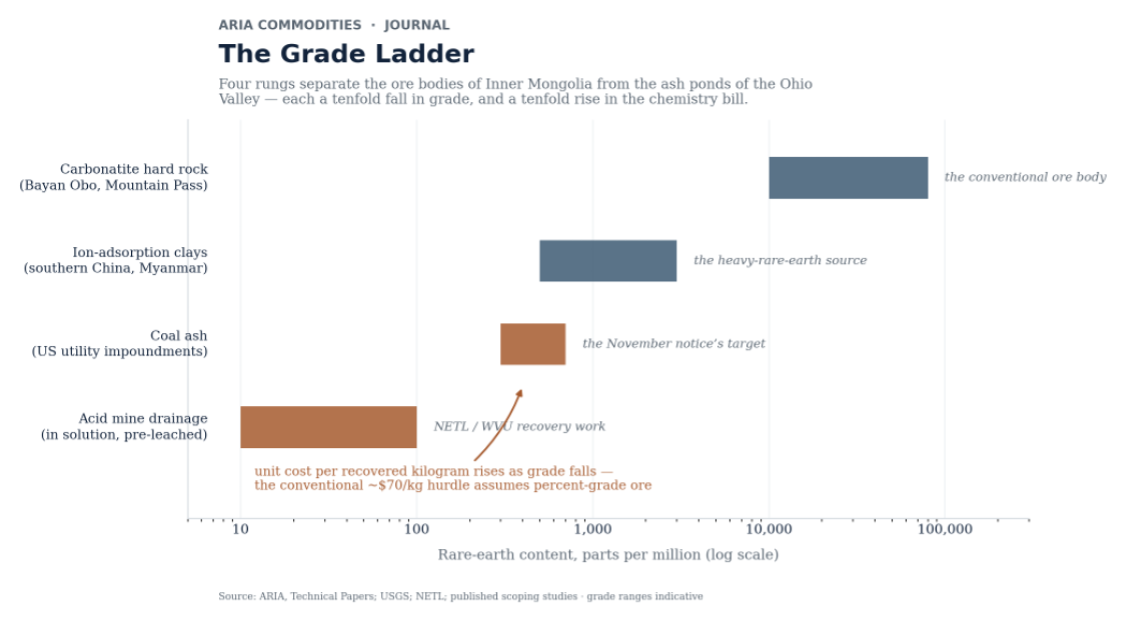
Figure 1: The Grade Ladder
A mine in Wyoming, and its critics
Which brings us to Ranchester, Wyoming, where in July Ramaco Resources opened the Brook Mine — the first new rare-earth mine in the United States in some seventy years, and, instructively, a coal mine. The Energy Secretary cut the ribbon. Last month the company broke ground on a pilot oxide plant and announced plans for a strategic stockpile, tripling its targeted output to around 3,400 short tons of oxides a year. This month, short-sellers and sceptical geologists have attacked the grade claims, and the company has answered in kind; the property remains, formally, at exploration stage.
We take no side in the assay dispute, because the framework renders much of it moot. The interesting question about Brook is not whether its carbonaceous ore is as rich as the promoters say. It is that under an administered price regime, the threshold of ‘rich enough’ is itself in motion — set in Washington, not in the rock. A deposit that fails at Shanghai’s price may clear at the Pentagon’s; a grade dispute conducted in market prices is an argument about a number the market no longer sets alone. The short-sellers may be right about the geology and still wrong about the investment, which is an uncomfortable sentence for everyone involved.
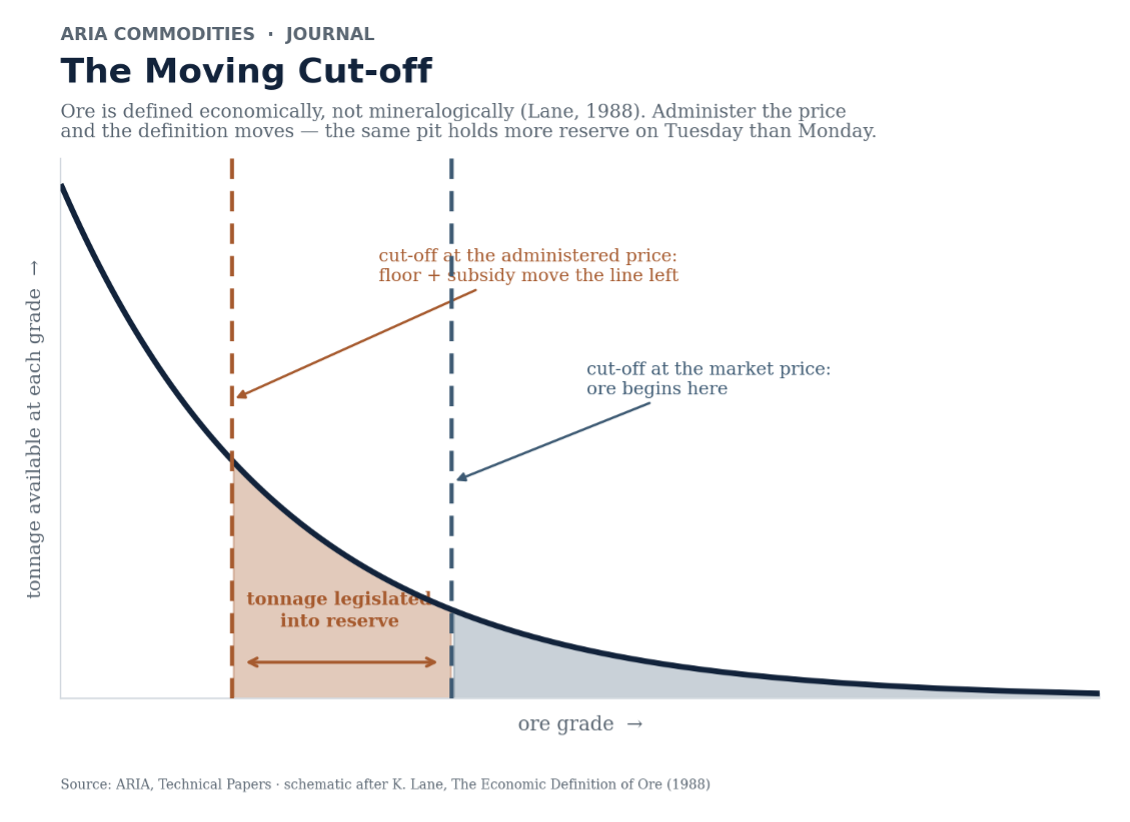
Figure 2: The Moving Cut-off
What the licence suspends, the floor entrenches
The Chinese side of the ledger reinforces the point rather than offsetting it. The 7 November suspension pauses October’s extraterritorial reach — the 0.1 per cent de-minimis on foreign-made goods, the controls on separation and magnet technology — for one year, until 10 November 2026. It does not touch April’s licence regime on dysprosium, terbium and the magnets that contain them, whose statutory 45-working-day clock runs, in practice, to 60 and sometimes 120. Nor does it alter the underlying dependency: roughly two-thirds of the heavy rare earths China processes are fed from the ion-adsorption clays of Myanmar’s Kachin State, a war zone, with the first commercial heavy separation outside China — some 1,500 tonnes a year in Malaysia — operational only since mid-year. Both blocs, in short, are administering; neither is discovering. A truce over licences changes the queue, not the regime.
The position
For allocators the implication is uncomfortable but tradable. Reserve statements across the ex-China complex are quietly mispriced, because they are computed at prices the state has ceased to respect: every dollar of floor and subsidy converts a measurable tranche of sub-economic material into reserve, and the equity market has not systematically repriced the conversion. We would own the assets the appraisal touches — the marginal deposits, the byproduct streams, the processing steps the November money must pass through — in preference to the flat price, which remains the property of Chinese quota policy. Applications for the notice close on 15 December; selections are indicated for the new year. When they land, the state will have named the rocks it intends to redefine. Lane’s theorem says the definition will hold for as long as the policy does. Policies, unlike grades, can be renewed.
Source: US DOE NOFO DE-FOA-0003583; US DoD/MP Materials disclosures; MOFCOM Announcements 61–62 and suspension notice; Ramaco Resources filings; Thunder Said Energy; USGS; ARIA research. This note reflects ARIA Commodities’ research views and is provided for information only; it does not constitute investment advice.