
March, 2026
Commodity desks price the cheapest barrel. States have started pricing the dearest kilogram.
The month the floor became a ceiling
In February, the Chinese benchmark for neodymium-praseodymium oxide did something the sceptics of July’s Pentagon deal had declared unlikely: it traded clean through the $110 floor Washington had guaranteed MP Materials, touching the highest levels in years before consolidating — the SMM domestic assessment peaked at $111.5 per kilogram on 25 February and stood at $103.8 on 10 March, still roughly double its level of late 2024. More interesting than the level is what the market has begun doing with the American number. Western buyers, market participants report, now treat $110 as a soft ceiling as well as a floor: reluctant to pay materially above the figure the state itself has blessed. A price invented as a subsidy has become an anchor for both sides of the trade. In eight months, an administered price has done what benchmarks take decades to do — organise behaviour.
Two curves, two customers
The commodity trader’s instinct, drilled in by a century of practice, is to price the left of the cost curve: the cheapest marginal producer sets the clearing price, and everything above it earns rent or dies. That instinct is correct for commodities with one class of customer. Strategic materials now have two. The commercial buyer still shops the left of the curve. The sovereign buyer — whose objective function is provenance, not price — has begun bidding the right: the last, worst, correctly-flagged kilogram, at whatever it costs. November’s $275m notice for coal ash and mine drainage was that bid in writing, as we argued then; grade is a policy variable, and the state has been moving it. The result is a curve with two prices attached — Shanghai’s at one end, Washington’s at the other — and a widening region in between where the marginal unit’s value depends on the passport it carries.
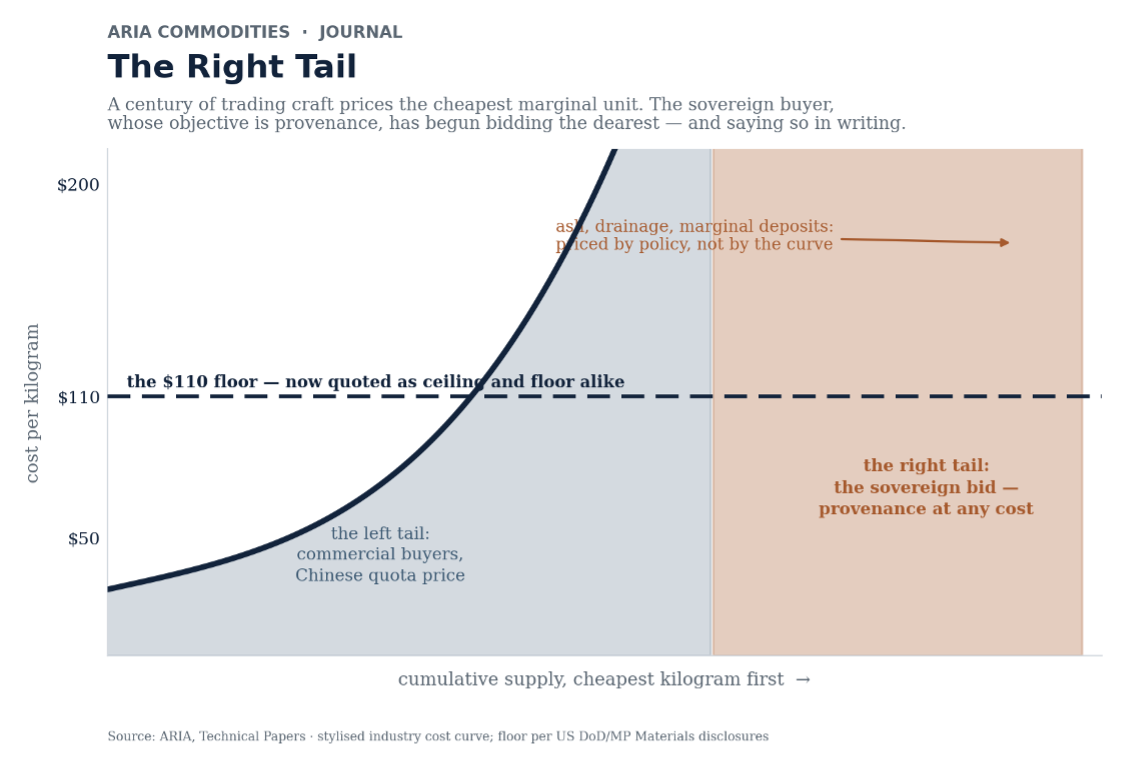
Figure 1: The Right Tail
The evidence is now physical
What distinguishes this quarter from every previous false dawn in Western rare earths is that the right-tail bid is producing objects rather than press releases. In Fort Worth, MP Materials has begun producing the first American NdFeB magnets at commercial scale — the country’s first mine-to-magnet output in a generation — with dysprosium-terbium separation at Mountain Pass indicated for mid-year. Lynas, having commissioned the first commercial heavy-rare-earth separation outside China last year, has shipped its first contracted ex-China dysprosium and terbium. Neither volume moves the global balance; China still commands some 85 per cent of processing, and more of the heavies. But markets price the derivative before the level, and the derivative has turned: the ex-China share of separated heavies has gone from zero to something, which is the largest percentage move available in mathematics.
The queue discriminates, and now we can measure it
Meanwhile the instrument on the other side of the spread has been used with growing precision. January’s additions to Beijing’s control catalogue — samarium, gadolinium, lutetium — and its new prohibitions on supply to Japanese military users extend a licence regime whose destination-by-destination discretion is visible in the customs data: European recovery, American stagnation, and now a third country introduced to the queue. The 45-working-day statutory clock, 60 to 120 in practice, remains the market’s true supply curve. We would note, with the February rally in mind, the forecast offered by at least one prominent analyst that the spike owes more to positioning than fundamentals and should correct by quarter-end. Perhaps. Our observation is narrower: whether the level corrects is a Chinese policy choice; that the structure — two administered prices, a discriminating queue, a sovereign bid for the right tail — persists, is not in dispute anywhere we can find.
The trade is convexity, again
We wrote in the autumn about buffers and duration; the same craft applies here with the axes relabelled. The flat price of NdPr is a policy instrument and will be volatile in both directions — chasing it is trading someone else’s decision. The durable exposures are the ones the structure guarantees work to: the separation, metallisation and magnet capacity through which the IEA’s estimated $60bn of required ex-China investment must pass; the floor-backed producers whose revenue is part-sovereign; the heavies chain, where Myanmar’s war-zone feedstock keeps the scarcity honest. And because the right tail is bid while the left is quota-managed, the optionality embedded in capacity itself — the plant that can process the flagged kilogram — is systematically underpriced in quiet months, exactly as tank storage was before the strait closed. The cheapest barrel made the old fortunes. The dearest kilogram, correctly flagged, is where the new rents are being written.
Source: SMM price assessments; US DoD/MP Materials and Lynas disclosures; MOFCOM announcements; China customs data; IEA; ARIA research; prior ARIA Journal notes (November 2025). This note reflects ARIA Commodities’ research views and is provided for information only; it does not constitute investment advice.